« April 2008 | Main | June 2008 »

May 2008

May 29, 2008

Twitter Reflections on a Milestone

Recently I hit the milestone of having 1,000 followers on Twitter. I'm not trying to boast, as I'm a big believer in quality over quantity, and I'm fortunate that both apply here. Still, it's a convenient time to reflect on what that means.

1) Friending vs. Following
One of the more interesting paradigms with Twitter is that there isn't the requirement of reciprocity that's common on social networks. On Facebook, MySpace, or LinkedIn, two people need to agree to be each other's friend. On Twitter, for all public accounts (which is the most common form), you can follow whoever you want, and there's no need for the people you follow to agree.

There are many reasons why you might not follow someone back:

  • They post too often
  • They post too infrequently
  • They only post about themselves
  • They only post links with no commentary
  • They're boring
  • You're overwhelmed by your current volume from who you're following and you're cutting back
  • You only follow people you really know

All those reasons are valid, and there are no questions asked (though if a significant other, boss, or client follows you, suck it up and follow them back to keep the peace, even if they fall into one of the bove buckets).

2) Some Followers Matter More
Not everyone following me matters. Okay, maybe that's a little dismissive, but there are several tiers of followers:
a) Followers who are subscribing to your posts via IM or SMS so they get notified of each one
b) Followers who are active on Twitter and are reading your posts on a regular basis
c) Followers who don't catch most of what you tweet but still see your tweets periodically, reinforcing your relevance in their network
d) Followers who connect with you because they know you or just think they should but never see anything you do; there's still a bit of value in that first point of contact, and it could grow down the road
e) Followers who are following everyone just to try to get more people to follow or even notice them
f) Brands, organizations, or other non-humans following you because you follow them or because they found you in some Twitter search, but who won't be going back and reading who they're following (
g) Twitter spammers - the get rich quick schemers, snake oil salesmen, and the like (a subset of category "e" but more malicious; it's the difference between a used car salesman who's a nice enough guy but you're wary of because of his profession, and the used car salesman who's actively trying to screw you)

I'd estimate that about 10% of my followers fall into categories e, f, and g, and so they don't matter as much to me; I don't need to attract followers to inflate my own numbers. That percentage is definitely more than 5% and has to be lower than 20%, but it's hard to keep track. And there's no real way of knowing the breakouts for a, b, c, and d, but as far as I'm concerned, I'm just grateful they're connecting with me here. (I also have no hard feelings for friends of mine who are on Twitter but don't follow me; as mentioned previously, there are too many good reasons for that to take offense, and I don't follow a number of people I respect immensely.)

In any case, maybe I'm Tweeting about this milestone too early. If it's really 20% who are in the 'don't matter' bucket of followers, should I wait until I get to 1,200? The content of this post would be the same regardless; the number's just for convenience.

3) Value of Network
Twitter gets increasingly valuable as more people follow you since, generally speaking, you'll have more people in the a, b, and c buckets above who might make for meaningful interactions. If you have a question, there are more people who can answer. If you have a great link to share, more people will get to see it. If you respond to someone, more people may provide their thoughts to that response.

An added bonus is that the size and quality of your network aren't all that matter. I recently posted that a friend needed help setting up a blog, and the one person who responded wasn't even following me (he was probably just tracking relevant keywords like WordPress). It wound up being a good fit, and the blog launched that day because of it. So you could have no one following you and still reap the benefits of people listening.

Having followers helps though. To my followers, thank you, and let me know how I can make my posts and interactions with you more meaningful.

Update: Be sure to read the comments. There are some very thoughtful, interesting stories of how people are using Twitter (and a couple ideas that I might include in a new version of this post). If you do comment - as I hope you do if you're so inclined - be sure to mention your Twitter name.

May 28, 2008

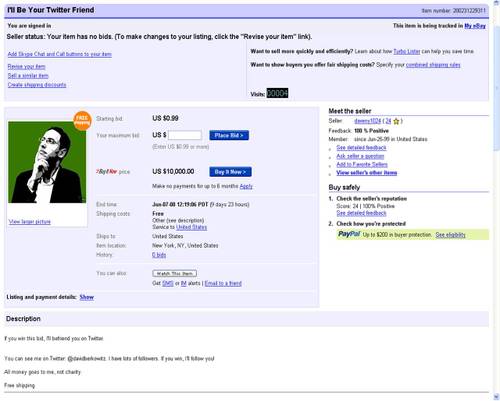
Because Greg and Ian Aren't the Only Ones Who Should Get to Auction Themselves on eBay

First Greg Verdino auctioned himself on eBay (and here's his blog post on it).

Then Ian Schafer did (and here's his blog post).

I feel so left out. Now I have one too.
Ebay_twitter_friend

SocialVibe: Widgets That Save the World

Finally, I've signed up with SocialVibe. I was inspired by a recent press release I received last week, even one of those barely personalized ones, which goes to show that good content is often all that matters. [An aside: I tried writing this post before and Flock crashed on me. I have to save drafts more often. Please tell me Firefox 3 will be more stable. Flock's recent funding may be too late.]

Here's an excerpt from the release:

In response to these tragedies [in China and Myanmar], SocialVibe.com, a new way to make a difference for charities online, is establishing a cause called Disaster Relief that will enable SocialVibe to quickly mobilize fundraising efforts when a global or regional disaster strikes. SocialVibe.com's Disaster Relief (http://www.socialvibe.com/charities/22#) launches today on the homepage and as the featured cause of the site. SocialVibe.com "Points " earned by selecting Disaster Relief will be allocated to charities within SocialVibe making a difference for Asia.

The gist with SocialVibe is that you sign up for a cause, pick a brand to sponsor it, share this widget, and earn points for the cause.

I'd be curious to hear some case studies on how well the marketing works, and what the brands are even trying to get at here. Is it just some cause marketing branding play?

I also wonder how much of a rush there is for consumers to put more ads on their profiles, which is basically what these widgets are. Yes, widgets are a form of self expression, and people do have their favorite brands. Interestingly, this is the second social site I've tried lately where I've been asked to list my favorite brands; the other is SocialSpark.

Still, there is the potential for one of those win-win-win-win-win..... types of deals.

One nit: it wouldn't let me update my school. I'd try to click save and it wouldn't do anything.

I also don't mean to get overly critical. There are lots of things I like about it. Very easy signup, smooth design, and the 'points' system (not unlike the Spock Power at Spock.com) gives some sort of motivation to do more. The membership upgrade from Gold to Platinum is very clever, where you have to spend a few minutes filling out more info about your interests to better target brands.

In any case, here's the code for my SocialVibe widget. I chose Perrier as my sponsor for two reasons: 1) I drink it sometimes, namely when I'm visiting the in-laws in Dallas, and 2) I felt like this older-skewing brand might need some extra love.

May 27, 2008

You Call That a Bribe?

Today's Search Insider column, originally in MediaPost

Microsoft’s new Live Search Cashback program has been routinely called a bribe by journalists and pundits. Microsoft and others have tried to bribe users before, but calling Cashback a form of “bribery” diminishes the meaning of the word.

Here’s how Cashback works: A consumer searches a Microsoft property like msn.com or live.com for a query such as “shoes.” In this case, three ads appear above the natural search results; the second one says “Buy Women’s Shoes: Save on shoes at Live Search cashback” with the URL Search.Live.com/cashback and a logo for Cashback beside it. The link leads to a page of shoe listings at the Cashback site. Clicking “compare prices” below the first listing brings up a table with store names, the original store price, the Cashback discount, and the new “bottomline price.” For the seven stores here, FootSmart has the highest store price at $91.98, but with its 25% discount leading the pack, it’s listed fifth, as the results are displayed by bottomline price.

If consumers click to go to one of these stores to make a purchase, they first enter an email address to register with Cashback to receive information about the discount. Then they must play the waiting game. First they have to wait to accumulate $5 in Cashback rewards, if they don’t get that much through the first purchase. Then there’s a 60-day period before redeeming it, allowing room for returns  – and it takes 14 more days to actually get the refund. One better hope the government’s tax rebates provide more of an economic stimulus, because this deal’s a lot of work. It can easily take ten clicks from the search through completing the transaction.

The consensus seems to be that Microsoft is bribing consumers to search and shop. Andy Beal’s headline in MarketingPilgrim was, “Microsoft Gives up Earning Your Loyalty; Launches ‘Cashback’ to Bribe You Instead.” Kevin Maney at Portfolio.com writes, “Good Luck with the Bribing, Microsoft.” InformationWeek’s Dave Methvin, who generally praises the product search experience at Cashback, still calls it “bribery” that “inevitably will have to end.”

So, is this really a bribe?

I have a hard time seeing it that way. Checking dictionary.com and other sources, there are two ways to define bribery. The first is usually illegal: offering money or something of value to corrupt someone’s behavior. Microsoft isn’t incentivizing consumers to steal Google’s servers or sell Yahoo stock en masse to drive down its price; Microsoft is incentivizing consumers to shop, albeit with merchants listed on its own shopping site. Do journalists hate Microsoft that much, to insinuate it’s doing something that nefarious? And yes, the question’s rhetorical.

Then there’s the second definition, worded on dictionary.com as “anything given or serving to persuade or induce.” Since you’re reading this column, you probably have some connection to marketing. Guess what marketing is all about? Persuading and inducing.

If Microsoft is guilty of bribery here, then we all are. Look at how Cashback works: Advertisers offer a rebate through Microsoft which Microsoft refunds to the consumers who make a purchase there. How come the press isn’t up in arms over every other rebate deal? Then look at it from the consumer’s perspective. I’m shopping for shoes, I see an ad where maybe I can save money, I choose a retailer I trust with a low price, I click the ad, and three months later I’ve got $5 in my pocket, along with a decent deal on Manolo Blahniks. Is this really any different than other comparison shopping sites, including Yahoo Shopping and Froogle, where consumers decide based on the product price and retailer’s brand?

That’s not to say I’m in love with the program. I doubt it will affect Microsoft’s market share, and Microsoft’s taking a risk. The rebate works as a cost-per-acquisition model for advertisers. Microsoft doesn’t take a cut and passes the advertiser’s rebate to the consumer in full. Microsoft then promotes the program with its precious search ad inventory, where it’s promoting Cashback for high-volume, high-value searches like “shoes” and “digital camera,” so it loses out by knocking other advertisers out of those spots.

Ultimately, with Cashback, Microsoft is offering a comparison shopping service for consumers who are already shopping. This is different from other promotions Microsoft has offered over the years that reek of bribery much worse than Cashback. Consider Micorosft’s “Search and Win” campaign from February 2006, where it offered rewards like electronics, sporting equipment, and gift cards for consumers who happened to perform a search on one of more than 1,200 pre-selected keywords in February (the list grew in subsequent months). Here, the incentive, or perhaps the bribe, was for consumers to do something they weren’t going to do anyway — first, search MSN, and then search for the keyword that would lead to a chance at winning a prize.

The campaign bombed. According to Search Engine Watch, comScore reported Microsoft’s search market share dropped in February, March, and April of 2006; Hitwise and Nielsen//NetRatings also showed MSN declining. The campaign’s domain, msnsearchandwin.com, now redirects to a French blog by Braun promoting its cruZer shaver that, based on the site’s artwork, seems to target gay men. N’est-ce pas?

As for Cashback, consumers will likely find it when they’re already conducting searches on Microsoft’s sites. Microsoft needs those users to convert to gain more leverage with Cashback’s advertisers so they’ll spend more with Microsoft. You could say Microsoft is bribing advertisers.

That’s not a bribe; that’s an incentive. If it is a bribe, then all marketing is bribery. And whatever Microsoft’s doing here, Cashback better work better than Search and Win. Consumers are smart, though. They may just hold out longer — until Microsoft ups the ante again.

Internet Marketing Conference - Mobile Marketing Event June 4

In a rare twist for me, I'll be going to an event next week ust as an attendee, not a speaker or blogger. What would motivate me to do such a crazy thing? Internet Marketing Conference's agenda for its upcoming event Mobile Marketing: The Next Evolution. Scroll down for a bonus discount if you plan on attending.

Sessions include:

  • Monetizing Mobile—Reward your Community for Marketing Your Brand by Alan Levy, CEO of BlogTalkRadio
  • Surfing, searching, and Sharing Mobile Internet Without Typing by Aage Reerslev, CEO of                                     Squace
  • Location Services Roundtable
  • Creating a Sticky Mobile Expereience by Ludo Collin, General Manager of Starcut
  • Widgets in Motion - Syndication Beyond the Desktop by Wil Tan, co-founder of MojiPage
  •                                   Promotional Marketing for the Small Screen by Jeff Weitzman, CEO of Coupons, Inc.

Full disclaimer: I'm not a media sponsor. I still hope to blog the heck out of this thing. But I have NO affiliation with that event in any way.

That being said, I did mention to the organizers that I'm blogging this and would be happy to mention it on the blog. It's Wednesday, June 4 in NYC, going all day.

Here's a bonus for you: I've got two discount codes for readers of this blog. The normal rate's $695, and the code will let you register for $199. Just comment on this post that you want to attend and I'll send you the code. That's nearly $500 off, which you can use to buy a Wii Fit, given the black market for those things.

Oh, and if you have any real aversion to commenting for any reason, email me at marketersstudio (at) gmail (dot) com. You can even write me on Twitter, if it's working. The first two messages I see get the discount.

If you're already going or plan to now, definitely drop me a line and we can catch up there.

May 26, 2008

Managing vs. Motivating

I caught this quote today on the Mets.com mailbag:

"Managers are in place to manage, not motivate." - Marty Noble, reporter, MLB.com

Managers are there to manage, not motivate? In the corporate world, if a manager only managed without motivating, the company's performance would suffer and the manager wouldn't last. What's true for corporate teams is true for baseball teams.

You can find a lot of great advice in sports coverage. Just not in this one.

May 20, 2008

Dreaming of a Super Model

Today's Search Insider column is based on coverage of Gian Fulgoni's keynote at the Search Insider Summit, still in progress here in Captiva Island, FL. Follow me on Twitter for more updates from the event, check out who else is tweeting the show, and read more at MediaPost's RAW blog. Also check the Search Insider Summit photo pool on Flickr.

Dreaming of a Super Model

Does search need a new business model?

ComScore Chairman Gian Fulgoni suggested as much in his opening day keynote at MediaPost's Search Insider Summit this week. He stressed that marketers are realizing so much more value from search than they're paying for, and that means there's money being left on the table. Here's some of his analysis as to why (read more stats in my blog's coverage of the session):

  • One-third of ad dollars are focused on brand building, which is the reverse of traditional media, so we need to figure out how to use search and display to increase branding value.
  • There are three components of how search drives buying: direct online effects (16%), latent online effects (21%), and latent offline effects (63%), so 84% of the value isn't being monetized by search engines, and marketers aren't generally measuring it.
  • Enquiro did a study that showed a 16% brand lift when a brand was advertised in the top sponsored and organic results, so even without a click, there was value.
  • ComScore's data shows that only about 5% of Google's paid links result in a click; the other 95% of ads are really "unpaid links," yet they deliver value to advertisers.

All of this led Fulgoni to muse that the cost-per-click model may not be the most effective. He noted that perhaps a cost per impression (CPM) model or another tracking view-throughs could better account for branding value and, in the process, bring over more branding dollars.

Here's the problem with that: the model and the measurement aren't the same. We don't need to rely on the pricing model to determine what marketers measure.

Fulgoni seems to be looking at the industry from the perspective of the search engines, which seem to be at fault for not monetizing searches as well as they can. It's ironic in light of last week's analysis of Jakob Nielsen's missive, where Nielsen suggested search engines were actually making too much money and should give some of it away. One says they're too poor, another they're too rich, and I'm like baby bear saying that in this instance, it's just right.

The search engines will probably do fine. Fulgoni said as much later, noting that while marketing is the first thing to get cut in an economic downturn and advertising is the first part of marketing to get hit, the accountability of search marketing can make up for it.

So, what would a CPM model add to search? In this economy or any economy, not much. Yes, it would show marketers that there is more they should value. At the same time, that would make search marketing much less appealing. There are competing forces: the engines aren't cashing in as well as they could be, but marketers have enough pricing concerns with search even when they're getting a great return on investment, let alone when they're struggling.

There are two major challenges preventing any sort of CPM model from working with search. The first is that the engines would consistently need to demonstrate the impact on branding, latent conversions, and offline conversions for every single ad that runs. Last I checked, comScore doesn't give that away. Still, the engines can continually strive to make their reports more robust, especially in ways that will appeal to brand marketers.

Secondly, search engines have shifted entirely to a performance model where they penalize ads that only deliver branding value. Some sort of immediate online action needs to occur often enough for the ad to rank well, if at all, or it will get bumped. I touched on this over a year and a half ago with the column " Google to PPC Branding: Drop Dead," and that was before Yahoo launched its

Panama

platform. This system is in place because the engines try to maximize the revenue per search and also to provide consumers with what's presumably the most relevant experience possible.

Maybe the business model, which works well enough for most parties most of the time, isn't what's broken. It's also interesting that CPM and view-through models would be seen as an improvement, as they still don't account for brand lift, latency, and offline impact without intensive additional measurement.

So what will bring more branding dollars to search? The key is developing integrated digital marketing strategies combining search with display, video, and social media, all backed up by behavioral targeting. Improving the measurement and reporting will help further still. None of this provides the panacea that could be accomplished as easily as changing search engines' pricing models, and it's all easier said than done, but it should help bridge the disparity illustrated at the

Summit

.

Jordan Rohan Keynote at Search Insider Summit - Live Blog

Jordan Rohan, founder of Clearmeadow Partners - a digital media advisory firm - and formerly of RBC, is now back on stage for the fifth consecutive Search Insider Summit. He may well be the only other non-MediaPost-staff person besides me to make it to every one of these events. Do we get a plaque?

Rohan's keynote:

Key developments in 2008: Liquidity, inflation, real estate revaluation

We're not in recession yet.
Liquidity crisis: halfway home: $350-$500 billion marked down. Very bad for profits of major banks, brokerages.
Inflation: feeling modest impact but no resolution in sight. Lesser of three evils.
Real estate revaluation: just rounding first base in some areas. Differs from town to town.

Liquidity crisis impact on search marketing:
* Fewer non-standard loan structures: teaser rates discouraged, fewer borrowers qualify for mortgages
* Higher % down payments and conservative appraisals
- Fewer borrowers qualify, fewer refis make sense
* Securitization outlets frozen
- Can't sell loans to remove from balance sheet
- need to hold loans, take charges for loan loss reserves
* If home refinance is not available, credit quality decreases for all other types of consumer finance
- includes student loans, credit cards, auto loans
- restrictions apply to corporate borrowers too
- adverse selection: wouldn't want to lend to those who need it

Lower conversion rates & lower bounty value per loan, fewer profitable keywords, lower total spend

At first, he notes this seems category specific. How does this affect other marketers?

Weak dollar, high materials costs abound.

* Fed rate cuts ushered in new era of weak dollar
- weak dollar alone doesn't make oil go from $60 to $127 per barrel
* Demand from BRIC for food, materials outstrips increases in supply
- steel, fertilizer, heavy machinery, chicken & dairy, wind, water, rice

Budget deficit tripled.

Good news: inflation relatively contained.

* Some cost inflation impacting online businesses:
- Shipping costs higher, lower margins for free shipping merchants
- Cost of imports up
   - Consumer electronics, branded fashion showing much higher costs, costs of consumer travel increasing, substitution occurring

* Consumer buying power reduced by expensive food and gas
- Get used to higher oil prices until we can reduce dependence on it and that's a LONG time coming
- Happening at gentler pace than indicated by consumer confidence
- 70% of corporate direct costs are labor, not materials

"We have not yet seen the effect of inflation. In my opinion, inflation is scarier than recession."

Bad news: real estate revlauation may take a few more years
* Revaluation matters more for investors, speculators
* Most severe in areas with greatest speculation including FL, CA
- Even within those stats, some areas not seeing major revaluation
- Neighborhood by neighborhood analysis required
* In areas of less impact, headlines worse than reality
- Secondary impact: headlines impacting consumer confidence and spending levels, which are impacting confidence of would-be borrowers
* Slow and steady impact on search spending, most yet to be seen
- We need to see how campaigns will shift when people lose buying power
- Think where there are risks to products focusing on, how the margins are being affected

How is this impacting Google stock?

* Google shares have found new equilibrium between peak ($700+) and trough ($420)
* Wait until August to buy - at or below $500
* Equilibrium P/E ratio of around 24x

Google growth quadrants:
* Google's US national sales team is missing internal forecasts
* Google's online sales and operations are making up for it
* International remains v. strong - ROW faster than UK

US Direct sales: 25% of total, 10% growth - low, low
US Online sales & ops: 24% of total, 35% growth - high, low
International early marketers (UK): 15% of total, <20% of growth - low, high
International emerging markets: 36% of total, 40% of growth - high, high

He has this has a 2x2 quadrant, which is what the lows/highs represent - a little hard to create here on the fly.

Google now over 40% of US ad spend

Discussing Microsoft, Yahoo courtship

Jordan used this graphic (from Googling "bad relationship" found here):
Bad_relationship

Jordan said at last event:
* Yahoo generates around $400MM/year in high margin fee revenues that his headed to run rate $150mm in 08 - could be as much as $200MM swing in EBITDA, forcing YHOO to guide below street
* EBAY, T, NWS, MSFT all had some level of interest
* MSFT favorite

What he couldn't have predicted
* Yahoo management treated 62% premium like bad diagnosis from doctor
* Jerry Yang in a tough spot now, legal liability if MSFT really goes away
* Icahn to the rescue?
- Patience may not be there, in MSFT interest to feign indifference right now, sit on the fence

Anything short of an acquisition of Yahoo will be met with lukewarm reaction from investors, so investors will continue to apply pressure.

* If Yahoo does primary search monetization deals with Google, Microsoft, then shares will head below 25.
* In MSFT best interest to wait
* MSFT won't realize $47 billion value from Yahoo
* Would buy Yahoo shares in low 20s if it gets there

Predictions for 2008
* Breakup good for IACI
* Current structure, IACI doesn't resonate with many investors
- Growth investors like search, media, dislike HSN
- Value investors like free cash flow of HSN, don't like implied valuation for the rest
* With Malone, Diller battle done
- Key catalyst is separation of HSN from rest of company

Facebook - Much to say
* Social media business models at crossroads
- Response advertisers frustrated because of low CTRS
- Brand advertisers are hesitant to commit large % of budget (~10%)
- Search monetization partners (GOOG) losing money on MySpace deal

* Necessary improvements to go beyond college, high school population
-Different usage patterns of users who are over or under 30
-Multiple profile views for different types of friends - company has announced this, not yet delivered
-Segmentation of inventory by sequence within each user session
-More tools to reduce news feed and mini feed clutter

* Not worth $15 billion, but one could easily see $6 billion+ now
- Worth more without significant cash flow

Predictions: Facebook stays independent long enough to go public, ad networks figure out how to segment Facebook inventory better

"Exit click" on social media inventory: basic exponential decay curve - could be there for a few pageviews or a thousand - but the most valuable click is right before you're done
* From a response basis, an exit click is something that everyone has to do - looks like an exponential decay curve
* Ad exchanges should separate by sequence - when someone sits down for a session on social media, leverage most valuable inventory for response-driven advertisers
* Search mindset will then take over social media world

Inventory quality, targeting drive decisions for ad buyers, but marketers and agencies are increasingly selective
* 74% use 1 or 2 ad networks in average media plan (separate from portals)
* 2 ad nets seem like magic number (43%), 3 networks used ~14%, more than that, around 12%

Today's stock recommendations
* Stimulus check trades: Darden (DRI), PF Changs (PFCB), Amazon (AMZN)
* Global consumerism: Tiffany's (TIF), Nike (NIKE)
* Contrarian: Home Depot (HD)< Silicon Valley Bank (SVB), pick your own conservative local bank
* Digital growth engines: Omniture (OMTR), Mecado Libre (MELI) below $50, WebMD (WBMD)
* Share gainers: GMarket (GMKT), MDC Partners (MDCA)
* Less of a mess: IACI - worth $30+ if split, some parts sold
* Speculative Russian Internet Stock - Rambler Media (London AIM Exchange) (he notes to be careful getting the right symbol so you do your homework - only buy a bit, use a limit order - only public Russian internet company, Rambler's like AOL of Russia)

Q&A

* LinkedIn's basically a Web 1.0 company - practically could live as app within Facebook but recruiters love it - there can be one or two business things that work in social media
* Healthcare - essentially a regressive tax since the costs are same for all income levels; plays into bigger factor lower income <$50K households, so it's why McDonald's and Burger King do better than PF Changs as people control their spending
* Q: Ad exchanges vs. ad networks: JR focused on this now. Conclusions: we don't need 7 ad exchanges. We won't get away with less than 2. There's this period where between DoubleClick, RightMedia, ContextWeb - three that are in the lead right now. Ad exchanges need portal beside it or source of high quality traffic giving more than remnant pageviews because right now it's a waste of people's time. RightMedia has a change to be a leader. Otherwise with remnant inventory, there are tons of places to get it. It's like a magnetic attachment - the ad exchange must be magnetically attached to that quality traffic souce.

May 19, 2008

Search Insider Summit Photos

Okay, so I'm a bit more enamored with the birds than the rest of the conference here at MediaPost's Search Insider Summit. We went on a "dolphin and shelling cruise" today and while we didn't see any dolphins, I'm also happy we didn't get shelled. It was fun exploring a different part of the island. Enjoy the slideshow below via FlickrSlidr; if you're on Flickr, friend me here (username: davidberkowitz).

Created with Admarket's flickrSLiDR.

Follow Search Insider Summit on Twitter

Follow Tweets on MediaPost's Search Insider Summit:

And I'm at @davidberkowitz.

My Photo

Who's David?

  • David Berkowitz is Director of Emerging Media & Client Strategy for 360i. A frequent speaker and media pundit, he has been published hundreds of times in MediaPost, Ad Age, eMarketer, and elsewhere. Get to know him in the links below the blog's header.

Contact

  • marketersstudio (@) gmail (.) com

Your email address:


Powered by FeedBlitz

Search This Blog:


Twitter Updates

    follow me on Twitter

    July 2009

    Sun Mon Tue Wed Thu Fri Sat
          1 2 3 4
    5 6 7 8 9 10 11
    12 13 14 15 16 17 18
    19 20 21 22 23 24 25
    26 27 28 29 30 31  
    Blog powered by TypePad
    Member since 11/2005
    Related Posts Widget for Blogs by LinkWithin