To close out the year, I started writing a post about what won't happen in 2016. All my favorite subjects centered on virtual reality. The column below originally ran in Ad Age.
Reality Check: 2016 Won't Be the Year of VR
10 Reasons Why Marketers Can't March Blindly Into Virtual Reality
If 2015 was the year in which mainstream marketers started caring about virtual reality, then in 2016, will VR become a budget line item? It's unlikely. Marketers' reality doesn't move at the speed of virtual reality. Here are 10 reasons why:
1. Goodbye, PR VR gravy train. One of the reasons why marketers have taken notice of VR is the public relations value of first-mover campaigns. In 2015, VR meant PR. In 2016, the PR hype curve will tumble downward as the press gets tired of writing yet another story about brands either creating a VR stunt that all of 10 people use, or brands shipping thousands of cardboard VR viewers that get buried in a desk drawer. The more campaigns that launch, the more they sound like copycats.
2. Massive scaling in VR. Without PR delivering reach, marketers will need to get people to use their VR experiences. In 2016, massive scale in VR will mean an experience that reaches a million consumers, so marketers won't be cutting budgets from publishers that reach hundreds of millions of people. The cost of reaching hundreds of thousands of people, let alone a million, will be astronomical relative to other media, and the payoff will rarely be worth the effort. There are app store models emerging, such as Oculus Share, but that alone won't overcome hurdles marketers will have in promoting VR initiatives.
3. Familiar adoption curves. Whenever technologies and media debut, consumers gravitate to them first and most brands follow years later. This has been true for various forms of mobile and social media, and it's happening again in fields such as wearables and the internet of things. VR should benefit from marketers taking a more hands-on role to promote the technology themselves. Still, expect the vast majority of brands to jump into VR later this decade only if it becomes a mass market hit with consumers.
4. Definitions remain murky. Will VR become a catchall for any kind of souped-up video? That's happening already. For example, Stanford Football recently described a 360-degree video post on Facebook as VR, but it's a far cry from an experience designed for headsets such as Oculus Rift. As the quality of higher-end VR improves, liberal uses of the term VR cheapen the brand. When a marketer promotes VR content, the consumer won't have any clue what to expect.
5. A plea to a higher power.Oculus Rift is designed to work with higher-powered computers designed for gaming. It's not the kind of device that can plug into a Chromebook. Smartphones are rapidly evolving into supercomputers, and VR hardware keeps improving to overcome those limitations, but that won't be solved in 2016, and that will limit consumer adoption.
6. Don't try this at home. A lot of the best VR experiences are customized for certain events and locations, with higher production costs and additional hardware requirements, from handheld sensors to equipment such as bikes and treadmills. After experiencing the full potential of VR in such a custom setup, toying with a handheld handset will feel like a letdown.
7. Searching for a killer app. VR often poses an existential question for consumers: When is strapping on a headset better than using a mobile app or watching something on TV? For instance, a live sporting event may deliver courtside views and the option to explore the action from any angle, but the tradeoff is that one can't kick back and multitask. Focusing on a single experience sounds like a great idea, but it's an uphill fight in our distraction-oriented culture.
8. Social is being redefined. Facebook, which acquired Oculus, is betting that VR will be a social activity. It's true to some extent, but VR makes it far more difficult to connect with people who are in the same room. VR today rewards sharing perspectives with people in remote locations while blocking face-to-face interactions.
9. VR lacks compatibility. Remember the fun of creating apps for both iOS and Android before most people had smartphones? Now all of that is coming to a head again in the latest Betamax vs. VHS showdown, but it's so early that the field of contenders hasn't yet been winnowed down. For instance, will Microsoft's HoloLens be a breakthrough or the next Google Glass? Will developers build great experiences for HTC's Vive VR powered by Steam? Marketers and publishers can't afford to bet on every device and format, so that will cause many to wait for a shakeout.
10. Make the logo less pixelated. If you grew up with PCs in the 1980s, you'll recall graphics standards going from CGA to EGA to VGA, or gaming consoles going from 8-bit to 128-bit and beyond. A lot of VR is still in CGA, 8-bit days, so some of the most protective brand managers will squirm when they have to spend minutes twisting dials on headsets to make their own logo look clear.
References abound calling 2014 the first "year of virtual reality," and that will be true for the rest of the decade. 2016 will bring far more VR interest from marketers, far more experimentation, and lots of stunts and gimmicks. It just won't be the year for consistently scalable, reliable, repeatable campaigns.

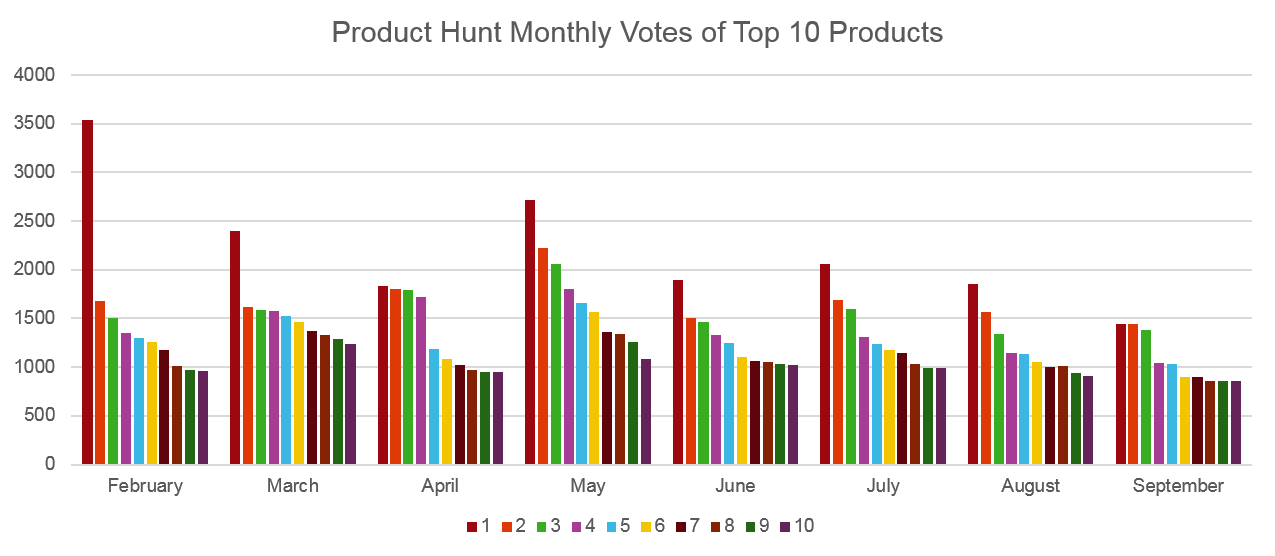
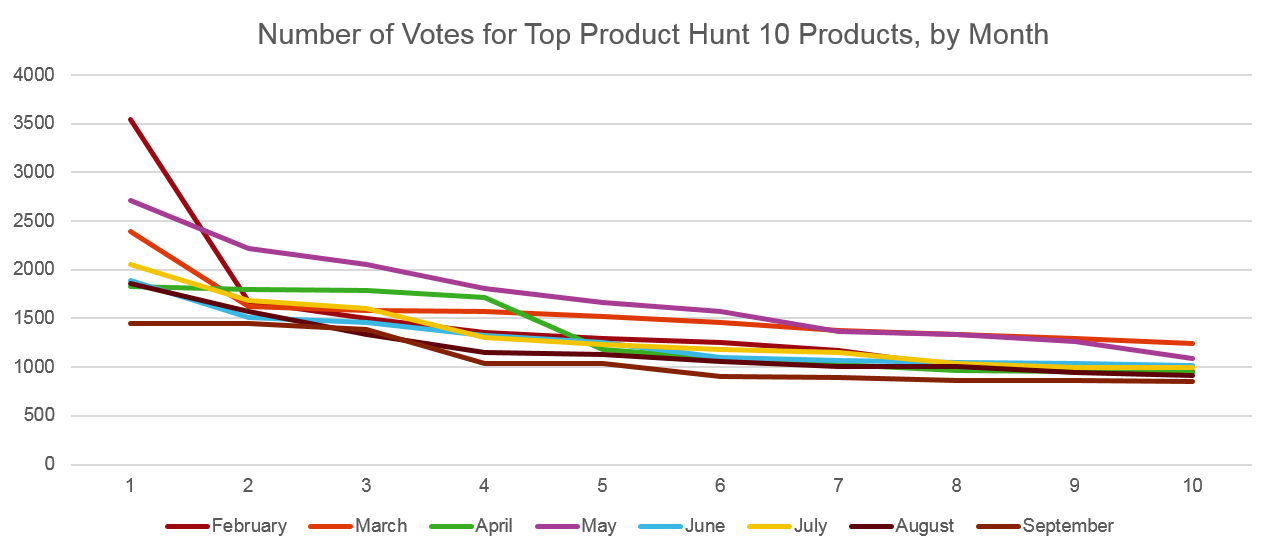
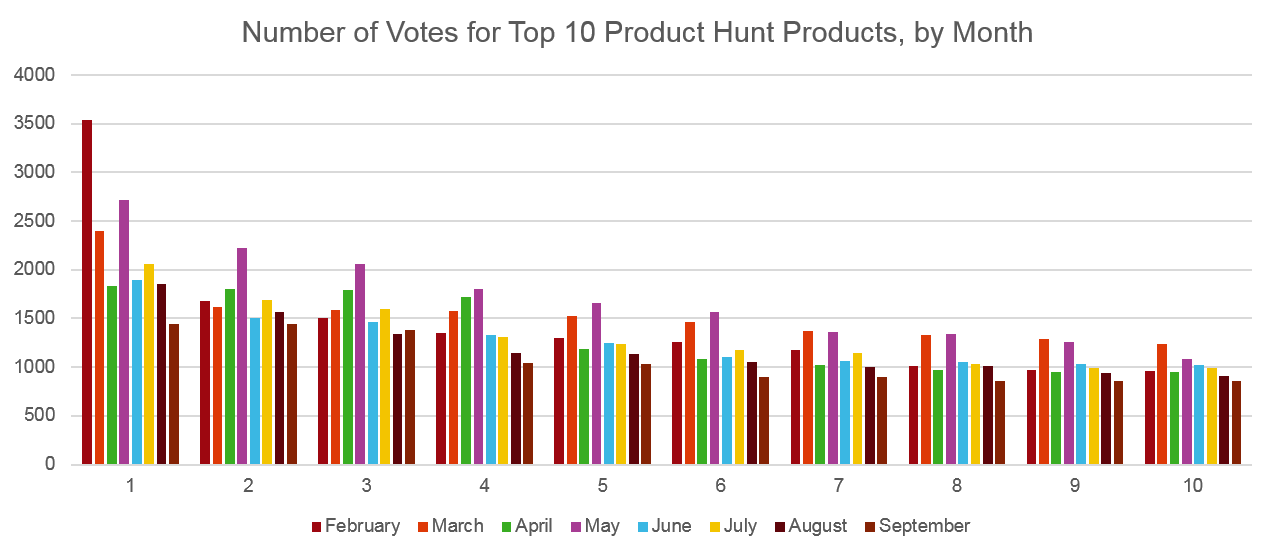
 Looking at this on a more granular level, we can see each month’s individual rankings more clearly, with a clear winner of a product for five months followed by tighter clustering. There isn’t some kind of power rule here, such as where the first is twice as popular as the second, and the second is twice as popular as the third. The amount of clustering is surprising. February’s 3541-vote standout, by the way, was