I've rarely been so confused as I was a few months back when I was doing an interview with Digiday about second screen behavior, and I had no idea which screen we were talking about.
Fast forward several months. Digiday invites me to be on a panel about second screen activity. I come out with a column in Digiday that morning refuting the title of the session. We'll see if I get invited back.
In the post, I write:
Beyond that, though, what is the second screen? Is it the PC or laptop? What about mobile handsets? Is the iPad the second, third or fourth screen? Based on that, what is the iPad Mini or the Windows Surface? How about the Kindle or the controller for the Wii U? Could Nike’s FuelBand be considered a kind of second screen, since it connects with an Xbox Kinect workout program? And then, what will happen when Google’s Project Glass eyewear comes out, allowing people to watch TV while Facebooking on their laptops, texting on their mobile handsets and viewing supplemental content beamed right into their retinas? Is there any first screen at that point, or do they all rotate in position and become the primary screen whenever that screen is what commands attention?
Originally published in MediaPost's Social Media Insider
Where were you when you heard that Osama was killed, or likely dead, or probably the subject of an upcoming White House address on national security matters? This is one of those moments that serves as a cultural barometer for the state of media today. It may be a fluke depending on what you were doing that night, but collectively the scores can be much more revealing.
Take this quiz to see where you stand. Pick the most appropriate answer, note the points associated with the response, and then add up the total at the end to see what it all means.
1) Which device first delivered the news to you? A: Radio (+1) B: Times Square JumboTron (+1) C: TV (+2) D: Telephone – someone called you (+2) E: PC (+4) F: Mobile (+6) G: Tablet (+6) H: Next day’s newspaper (-1) I: None – I witnessed it in person within the walls of my $1 million compound, and I don’t have phone or internet access anyway (-100)
2) When did digital media first play a role? A: I went to a mainstream media site after I heard about it elsewhere (+1) B: I found out first online from a mainstream media site or email alert (+2) C: I found out on Facebook (+3) D: I saw it on a blog (+3) E: I went on Twitter after hearing about it elsewhere (+4) F: I found out originally on Twitter (+6) G: I saw it on Reddit (+10) H: My name is Mohcin Shah or Sohaib Athar and I inadvertently live tweeted the raid on the Abbottabad compound as it was happening (+50)
3) Who was the source of the news? A: A mainstream media outlet (+1) B: Someone employed by a mainstream media outlet such as a producer, anchor, or columnist (+3) C: A friend or family member (+5) D: Someone you don’t like and should have unfriended or unfollowed awhile ago (-1) E: Donald Trump (-20) F: The Americans who stormed my compound (-100)
4) When were you first exposed to the news? A: When President Obama announced it (+1) B: Around 11pm EST, after news had spread but before it was confirmed by the White House (+2) C: Between 10:30pm and 11pm EST as early reports came in (+3) D: Between 10pm and 10:30pm EST, before any major news outlet reported it (+5) E: The next day (-1) F: As it was happening, as Mohcin or Sohaib first tweeted it (+20) G: As it was happening, as the Americans were storming my compound (-100) H: Before it was happening, because I’m one of the elite members of the US Armed Forces, I’m on the National Security Council, or my name is President Barack Hussein Obama (+1,000,000)
So, how did you do? Here’s what your score means, based on this pseudoscientific analysis:
-99 to -6: You’ve need better taste in news sources.
-5 to -1: Who printed out this column and left it on your desk? Or did they fax it to you?
0 to 5: You’re totally mainstream. There’s nothing wrong with that. Heck, most Twitter users who think they’re so trendy are just getting updates from mainstream media, so you do it without the middleman.
6 to 10: Digital media plays a significant role in your media consumption. You may like the control it offers, or you may like to be among the first to know, or you may have had to work late that night. It’s doing something for you though.
11 to 25: You’re loving digital, and you’re probably pretty active in social media. You’re well connected or at least connected to the right people, places, and things, and you’ve got a hankering to be among the first to know. Or maybe you were in the right place at the right time. Come on though – you know you create your own luck.
26 to 1,000,000+: You’re awesome, or were in the right place at the right time for a historic event. Who needs media when you create the news yourself?
Oh, and if you got a score of -100 or below, I’ve got two words for you: you’re next.
Now that you’ve taken the quiz, share it or leave your answers in the comments. Better yet, submit your responses at this public version and we may revisit this in a future edition.
It's funny, I spoke at South by Southwest (SXSW), put up my presentation on SlideShare, and forgot to blog it. So I'll admit, you're not always the first to know just because you read this blog, but I still am immensely appreciative you're here.
I guess one reason I wasn't in a huge rush is that it's a talk that doesn't lend itself well to static content such as a blog post. I was the sixth speaker in a track of some brilliant 15-minute presentations on convergence, courtesy of Dan Shut of Resource Interactive, whose amazing presentation is available here.
My talk was designed to be more thought provoking and somewhat theatrical. I don't know anything about the future, and really, who does? So instead of just making a prediction, I decided to show what three futures look like. Since I wrote out the speech longhand (admittedly while sitting at another event... I'm not naming which one), I have the text and slides handy, and I even made sure to cite the image sources in the appendix.
Posting the notes isn't the same as seeing it live, but perhaps there are some benefits from reading it. If you do get through it, what future resonates most with you?
Note: If you're ever inclined to share the direct link to the speech, I shortened the URL to http://bit.ly/sxsw2015. That links directly to SlideShare, not here.
Today I sat in on the Future of Media summit from MediaPost held during Advertising Week.
Mark Cuban, Chairman & Co-Founder, HDNet / Dallas Mavericks owner
Vivian Schiller, President & CEO, NPR
Bob Garfield, Columnist, Advertising Age
Martha Stewart, Founder, Martha Stewart Living Omnimedia
Reid Hoffman, Executive Chairman and Co-Founder,LinkedIn
Susan Whiting, Vice Chair, Nielsen Company
Rob Norman, CEO, GroupM Interaction Worldwide
Judy McGrath, Chairman & CEO, MTV Networks
Milton Glaser, Founder, New York Magazine / Milton Glaser Inc
Moderator: Chris Anderson, Editor in Chief, Wired Magazine
They say pictures don’t lie. If that’s the case, the panelists looked agonized. It felt somewhat more upbeat, but all in all, it sounded like a lot of banter with no answers to big issues like where media’s going and how these companies are tackling monetization. You can also find all my photos from the event on Flickr; they’re under the Creative Commons license so feel free to share and use them if you like.
All of this pontificating about the future of media gave GroupM CEO Rob Norman a migraine.
Mark Cuban, Bob Garfield, Martha Stewart: all brilliant, but none too bubbly
On to the panel coverage…
Chris: “We don’t have to disagree about what’s happening anymore… It’s clear what people want, so now the question is, ‘What are we going to do about it?’” He took issue with the word “media” and wonders what it even means anymore. To Vivian – NPR: “I believe this is the golden age of the spoken word because we have so many ways to receive it.” He sees NPR as the “atomization of content.”
Vivian: “It’s destroying the original business model of public radio and NPR.” NPR didn’t used to go directly to consumers. Stations “need to become increasingly relevant to their local market.” She doesn’t care where people listen as long as they do. She sees a future not too far off where listening to her content on the iPhone far surpasses the audience of 28 million who listen on the radio.
Milton Glaser and Chris Anderson
Chris: To Judy, MTVN – What are you doing differently?
Judy: “We have atomized content, we have the advantage of brands…, relevance has always been the name of our game… the advent of social media is an opportunity, the proliferation of mobile is an opportunity…” She sees music once being a defining preference, and now comedy is taking much of that role.
Chris: This economic crisis has revealed the limits of advertising and the need for alternative revenue streams. To Martha: How does this crisis change how you run the business?
Martha: “Our business plan is still a good business plan.” The Omnimedia model “still works” and “at the center of the model is content.” Monetization is still a challenge. “The consumer is all-important to us, whether he or she is a reader or viewer or Internet user.” They develop programs for advertisers – she notes they’re effective and loved, but monetization is the challenge. [I’m not sure how she says the model works and they figured it out, but monetization is still a challenge.] Merchandising is also important for their consumers, as a way to satisfy their dreams and help them “become the doer.”
Chris Anderson
Chris: To Rob: “Do you see the limits of media?”
Rob: “We know now that addressable media, social media are of equal influence [to broadcast].” The question becomes how much more than advertising media companies can do.
Chris: To Reid: “You represent the competition… “ If he ran a major media company, what would he do?
Reid: He [not surprisingly] sees social and Web 2.0 as a bi“A business model is not just something you slap on top of content production… those ecosystems are changing.” As Chris elaborated, Reid doesn’t want their jobs.
Mark Cuban and Vivian Schiller
Mark: “Free as a form of sampling is very valid… it’s been used by drug dealers for years and years.” “In the analog world, we’ve assigned value to things that have become free.” It’s that “legacy perceived value.” “The Internet IS becoming stale… What’s next?…” At the Giants-Cowboys game, everyone was talking about the screen. It cost $40 million – what will it cost in five years?" It used to be “smaller, cheaper, faster.” Now it’s “bigger, better, and cheaper.” The focus on the Internet means “you’re missing all the good stuff.” He’s looking at mobile, screen, laptop… He notes the Internet is mature. “Once it gets so mature, the business models aren’t there.” … “How do you get to ubiquity? Through maturity?”
Susan: “That idea of best screen possible enabled by content – it still matters.”
Mark: “What’s premium today is going to be ubiquitous tomorrow.” Today it’s Twitter, social networks, etc…. six years ago it was something else. “How do you get ahead of the curve?”
Mark Cuban and Bob Garfield
Bob: “I know how to get ahead of the curve.” If Dallas has a 7-story screen, the future is 8 stories tall… “In the very near future, everyone in this room will be curled up in the fetal position whimpering.” Nobody will be paying for content. Fragmentation and the glut of supply is destroying the critical miss. Craigslist obliterated the newspaper industry and DVRs and the Internet are destroying cable. “CBS and NBC are talking about becoming cable networks.” Cable has much better prospects.
Milton: “The combination of words that most scares me is ‘targeted consumers.’”
Martha: They’ve been watching the erosion of church and state between advertising and editorial.
Chris: “It is paradoxical.” They assumed advertising and content needed to be separated. “The consumers clearly like it because they click on it.” “Either we were wrong… and we were just suffering from self-importance” or it’s different online.
Martha: I think there’s a relaxation online. “It doesn’t bother me anymore.”
Bob: “There’s a big difference between relevance… and corruption…” “Now it’s becoming like Plato’s retreat.”
Martha: “Look it up on Wikipedia.”
Vivian: In legitimate newsrooms this isn’t happening.
Judy McGrath and Milton Glaser
Judy: “Fake news has been very, very good to me… The consumer is more discerning than we give them credit for.”
Chris: “Are you happy about paying more and more for smaller and smaller audiences on broadcast?” Also, how does he reconcile that with online video?
Rob: “The value judgment I make is the exchange of money for effectiveness… We believe there is still a premium to be paid… for the volume and reach… we are trying to blend the costs of that with all the alternative forms of distribution that we have.” Advertisers feel pressure from many areas: television, Wal-Mart, distribution and logistics costs, Amazon, etc - “their margins are being stripped away.” … They must strip away waste.
Chris: To Judy, after she mentioned the success and viral nature of the Video Music Awards: “How did you monetize this?”
Judy: “We prepared in advance for this.” “We’re probably creating 50 pieces of content across multiple brands…” “These are the most marketed to generations in the history of time.” “I’m not saying we have the answers figured out, but we’re in the process of figuring out how to make great experiences happen and get compensated for it.” [Note: she still didn’t say anything about how it was monetized.]
Chris and Judy debated this – he still wanted to know how it was monetized and she said he was taking it too literally, as the audience grew.
Judy: “It isn’t the apocalypse. It’s quite the contrary.”
Reid: “It’s a failure of imagination not to believe that innovation will happen.”
Mark: There are “imitators, innovators, and idiots.” You need to recognize where you are on that scale.
I’m still wondering what I learned from this. But with Bob, Mark, Martha, Judy, and Chris sharing the stage, it made for a fun couple hours.
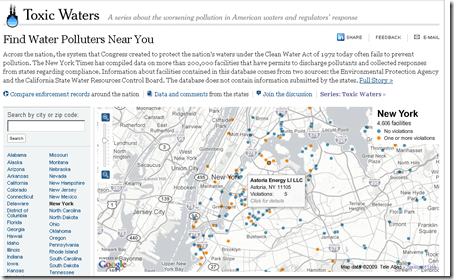
The New York Times has a series on United States water pollution now that it calls Toxic Waters. Check out this excerpt:
The Times obtained hundreds of thousands of water pollution records through Freedom of Information Act requests to every state and the E.P.A., and compiled a national database of water pollution violations that is more comprehensive than those maintained by states or the E.P.A. (For an interactive version, which can show violations in any community, visit www.nytimes.com/toxicwaters.)
In addition, The Times interviewed more than 250 state and federal regulators, water-system managers, environmental advocates and scientists.
This is ‘traditional’ media showing why the media industry matters so much. And The New York Times is using the Web to provide a public service that complements its story.
This is a public good, with efforts that few if any bloggers could muster – though one could imagine some sort of crowdsourced version of the database with a wiki to back it up if it had a strong enough and passionate enough project lead. The reporting though takes it a step further – both are essential to tell this story.
Yesterday I shared some somewhat random thoughts on Microsoft’s new search engine Bing (see the post on The Bing Bang). A lot of these thoughts came up in conversations with the press, some of which were going on while I was still trying to access the latest demos Microsoft was uploading.
Here’s a roundup of a few different thoughts that I shared with the media, in case you’re following this story as well. I’m not sure how well this is going to do for Microsoft’s market share, and the odds are clearly against them as Google’s track record has shown, but everything I’ve seen so far indicates that this is a smart, ambitious effort from Microsoft and they’re putting the consumer experience first.
"Even if they really believed this was the Google killer, I think they know enough not to say so," said David Berkowitz, director of emerging media and client strategy for 360i, a digital marketing agency. "That's always the kiss of death for any new search engine."
I just Googled “google killer” (with quotes) and the first page of results includes several mentions of Wolfram Alpha, plus nods to Cuil, Twitter (yes, really), and even Bing. The comparisons are generally overblown, but it’s interesting to see who makes the connection. With Cuil, the founders themselves were guilty of the hype (I blogged about their launch when they made a fuss about having the biggest index). Wolfram Alpha’s founder keeps dismissing it (I covered this previously with some not-so-gratuitous Monty Python references). The Twitter comparison is generally made by journalists latching on to a hot trend (guilty: I wrote about why Google needs Twitter Search). As for Bing, Microsoft’s in a tough place because they’re trying to say how huge this is without setting expectations so high that they’ll eat their hats later.
Video and image search has been the most impressive improvements. The ability to hover over an image or link to see the content on the connected page will prove valuable. "Microsoft is doing a lot to show improvements in multimedia," says David Berkowitz, director of emerging media and client strategy at 360i. "This is where you will see the most notable changes and clear-cut difference." …
As for the advertising campaign promised to roll out with the new search engine, Berkowitz says, Microsoft will need to do a lot to get consumers excited. The company has seen a couple of hits and misses lately. The Jerry Seinfeld campaign had a lot of people scratching their heads. The price-conscious PC vs. Mac ads demonstrate more finesse.
If you take a close look at the demo reel on decisionengine.com, you’ll see the multimedia results are going in some new directions. Can’t wait to spend some time with that, and video/image search is only getting bigger.
David Berkowitz, director of emerging media and client strategy at 360i, is impressed with what he’s seen so far with Bing. “I’m still waiting for the full picture, but this is easily Microsoft’s best search experience to date,” he said. “This is a very serious upgrade.”
Still, Berkowitz injected some caution: “This is what most people have been waiting for from Microsoft for years. But now Google is only more entrenched. For Bing, the presentation is the most obvious change. I’m very curious to see how much more relevant its results are. Relevance is something that you notice only when its not there.”
Microsoft’s marketing plan for Bing -- estimated at $100 million -- may be just as crucial as the product itself, since most Web users don’t seem as dissatisfied with Google’s ability to deliver relevant results as Microsoft might think.
“I’m wondering how much the average consumer is going to be able to tell this is something different,” Berkowitz said. “The ads need to communicate that. If you look at the growth of Google, people only keep relying on it more. If it really stunk, Google wouldn’t be in the position they’re in.”
I’ll let that speak for itself. Microsoft just sent me preview access for Bing, so it’s time to use the real thing. More to come…
I don't usually repost stuff from the major blogs -- this one's via TechCrunch -- but this one is too good, and everyone remotely interested in online media needs to watch this. Original source: PopURLs on Twitter.
Overall, I found the traditional media panel more compelling for a number of reasons:
Times are especially tough for traditional media companies, so it's really great timing to hear their strategies for dealing with this.
The brands themselves -- New York Times, FT.com, Nightline -- are all powerhouses with long organizational histories to share.
There was more time in total for the panel since they went first and ran a bit long.
The last panel was more about tech demos with less time for Q&A, so the first panel had more to say.
That being said, the online panel did have some great insights, from the old media exec who became a tech entrepreneur, Keith McAllister, to the wunderkind who's taking on print publishing behemoths, Jordan Goldman.
My notes from the session are below; most of them are paraphrased but exact quotes are noted.
Moderator: Tom Goldstein, Professor and Director of Media Studies Program, University of California, Berkeley
As opposed to the traditional breakfast, this started with pitches and demos.
Image via CrunchBaseHarris: You can always leave publishers and go to Google. Apture helps publishers harness the rest of the web and bring it on their site. [I've used this on my blog, but haven't gotten into it yet. Unlike another plug-in, Zemanta, which I use religiously - both of which I encountered for the first time at Blog World Expo last year, Apture enhancements are done in post-production, once the content's live. I like what it can do, but I'd love to incporate it during the writing/production process."]
Image via CrunchBaseMcAllister: Mochila is attempting to reinvent the content syndication business with an advertising model. They take high quality editorial content and create custom publishing solutions for advertisers, and then can have any online publisher get it for free as they put ads on it. "Online publishing remains the wild, wild west." There are a few exceptions (eg NY Times). With online publishing, it's just a question of how talented and creative you are, and then if you're going for a vertical or scale.
Spiegel: True/Slant's creating a network of contributors - anyone with expertise in a particular area. They get everything they need to create a digital presence. [She's first one to mention Twitter.] A contributor will have a specific perspective. They won't cover sports, but they might have a niche like athletes' wives and girlfriends, or coaches who should be fired. The consumer can then participate. Received funding in June from Forbes Media and Jonathan Miller's Velocity. Now in alpha with 20+ contributors. Image via CrunchBase Goldman: While a freshman in college, he launched a college guidebook, "Students Guide to Colleges." After college, he wanted to bring it online with editorial teams, plus a team of unpaid interns who they sent Flip video cameras to. They got 5-10% of students for the target 250 schools. Got 35,000 pieces of content. The site went live in September after 9 months of stealth mode.
Goldstein [I'll try not to mix this up - Goldstein's the moderator, Goldman's the Unigo CEO]: What are your financial models?
Harris; It's free for individual use. There will be a premium version for individuals with more customization. With large publishers like Reuters and Washington Post, they pay a licensing fee per month.
Spiegel: We will be an ad model. Contributors will be credible, distinct voices. Considering rev-share for contributors.
Goldman: It's a mix of advertising and lead generation.
McAllister: Mochila shares revenues with content producers and publishers. The model evolved toward a premium advertising model. For the high end of brand advertising, they want a better kind of ad environment like custom brand environments. "Over the course of the next two years... display ads will start to reach the performance level of search advertising." That changes dynamics and impacts how much online publishers can make.
Due to a lack of time, it went right to audience Q&A from here.
Q: How does Apture rank source authority?
Harris: We're looking for freely licensed content that we can bring into a page. Premium publishers get to put their own content at the top of related search results lists. Meanwhile, when your readers are going to leave your site, they're going to wind up going to Wikipedia anyway.
McAllister: All machine aggregation technologies - none can deal with authority issues in terms of how the question was raised. There's a degree of consumer trust in certain publishers.
Q: Between the two panels, there's a divergence in the treatment of content. With some new media companies, there's more of a sense of news as a commodity. Is that what you're seeing? Or is news a unique resource that should be owned by the producer?
McAllister: I would challenge your premise. News has been a commodity since the Associated Press launched in 1866 and newspapers pooled resources to cover a war. In web publishing, you get machine aggregation sources, and then hybrid sources like Huffington Post. The New York Times has aggressively moved into aggregation. This has always gone on but the web makes it so much easier.
Q: How are you dealing with the recession?
Spiegel: There are two parts. From funding, we redid our budget. We're good to go through at least Q1 of 2010. We feel quite comfortable. The second part is that what's happened with the news industry has been good timing for us. Journalists who are now let go with their severance packages are coming here, so there's great talent.
Goldman: We redid our budget and diversified revenue streams. Largely our content creation is free. When the economy's rough there's an incentive for consumers to use our free site.
McAllister: Like any company we restructured to make sure our financing met our goals. With brand advertising "there's been a flight to quality." What's over is the age of purely ad-supported digital businesses. Look up GlobalPost.com which is an attempt to reinvent the business model for global digital reporting. They have 65 international correspondents covering news for the American audience. Their business model is advertising, paying for premium content, and ecommerce.
This morning I attended a breakfast eventfrom Gotham Media Ventures on The Future of News and Information at the Harvard Club in Manhattah. There were two panels and I'll break this up into two posts for readability. My notes are below; most of them are paraphrased but exact quotes are noted.
Moderator: Andy Nibley, Chairman and CEO, Marsteller
Martin Nisenholtz, SVP, Digital Operations, The New York Times
Chrystia Freeland, US Managing Editor, Financial Times
Tom Bettag, former Executive Producer, Discovery's Koppel Group, ABC News Nightline
Nibley: How does traditional media survive in the digital era? In the current economy, how does anybody survive? To NYT: You haven't been able to fill in the gap with digital revenues. What's the future? Image by jdlasica via Flickr Nisenholtz: Part of what we've achieved is to keep providing a service to the readers that extends the fundamental benefits of print into the digital era. Our audience growth is a fundamental pillar of media. "The number of people coming to us has absolutely exploded in print and online." On the word "demise": "The New York Times is far from dead." Fact: people who subscribe for two years have essentially no churn - they die, or they move far away. "You can see a path to viability over the long term." "It begins with the journalism" and that people want and need that journalism on a daily basis.
Nibley: Christian Science Monitor was the first one to give up on print and shift to online focus. There's a big question about how people pay for news.
Freeland: The business question is the central one. She took over the site in 2001, and experienced the tech bubble bursting. FT.com became a pariah. It's a reminder of how far traditional news organizations have come. "We are very digitally savvy. It's not a big deal to break stories online. We do that every day." Of about 500 FT journalists, only around 10 are online-only. The real problem is the "digital quarter" - the advertising with digital is a quarter of what we can get in print. The recession is taking out a lot of newspapers. The real place of stress is in US metro dailies. There used to be a lot of really good ones, and now they're failing. We're going to see failure after failure. But this is positive. "I think the sad truth is that what the internet exposed is an oversupply of quality content." As the supply shrinks, she hopes that the survivors will have more pricing power.
Nibley: What's the future of television news? Traditional network news is slowly eroding.
Bettag: I would argue it's not quite bleak enough for broadcasters to get into the traditional age. Websites are just companion pieces. They're making too much money. A modest proposal: If you took all broadcast producers in a room and shot them all, you'd lose two or three good people. "It's gone way too long without having a wildfire go through, but you have to get out that dead wood to get those new sprigs to grow up." They're making so much money off of advertising that there's a vested interest in keeping people as couch potatoes where you can force advertising down their throats, and in the digital age, that's not going to work.
Nibley: Why don't consumers want to pay for news?
Freeland: "I don't think that's true." They charge for content on FT.com. It's growing and they're charging more. It's been hard because there has been an oversupply. With hundreds of papers giving away their content away for free, it's harder for a more general paper like the New York Times to charge even when the content's better.
Nibley: What about the "digital quarter"?
Nisenholtz: As for oversupply, he grew up in Philly and the Philadelphia Inquirer could charge. Why can't the Inquirer charge for Philly.com? Do you think they can?
Freeland: Sure.
Nisenholtz: There isn't any fact to support that. Classified ads are databases - the lifeblood of local newspapers. "When the internet came along, it didn't create supply for local news. I can't think of a single local news experiment on the web that worked." When you look at what the internet has done for advertising, you have to look carefully. Display advertising in print is not dead. From a category basis, the vast majority of money that has been taken out of display has been in classifieds. "Anytime a response is required from an advertiser, you'll naturally see the internet having a significant effect." Procter & Gamble spends 2% of its money online.
Nibley: "The reason is they're selling soap. It doesn't make economic sense to use the internet to sell soap."
Nisenholtz: The automotive marketplace is going to be decimated by the internet. But not all categories in all media.
Nibley: In the online ad world, search is a large part of it. Will online advertising rise to where display/classified advertising is now (in print), or will print go down to online dollars? I think online CPMs going up and up. I think the rates will come down in newspapers. The pharma industry is basically financing network news now and newspapers.
Freeland: You have to make a distinction between general and niche, and not just for print but for TV. That's what FT is and that's where the ability to charge for content is stronger.
Bettag: Can you get people to pay for news? We're looking at an audience that will pay an enormous mobile phone bill and a huge cable bill. People will pay big money for the monthly rate of information. They'll spend if they think they're getting something that is special. News is so broad. What can we give them that will make their lives better?
Nibley: Our research shows that Millennials don't read. They absorb information with audio and video. It's just a different way.
Audience Q&A
Q: In journalism school, we talked about e-paper. Whatever the future business model is, it depends on the delivery device. Where are we on that?
Nisenholtz: We've done a lot of research on that. Print is a technology. People pay for the technology - it's portable, visceral - there are tremendous benefits. E-paper has the same potential. We've been through three generations of e-reading technologies. We've participated in all of them. "For the first time we're seeing a little bit of light at the end of the tunnel with the Kindle. We are encouraged by the amount of use that it's getting with respect to our products. And people are paying for it. But it's still very, very, very early days. It's too soon to make a generalization about it." Future devices won't be monochrome. Aplle may come out with a larger form touchpad. "You'd have to see an advertising marketplace evolve around it to and that requires scale."
Freeland: "I totally agree... Kindle is incredibly hopeful." If you took newspapers and wiped out print and distribution costs, we would all be incredibly profitable businesses.
Q: I always thought the key to survival in the newspaper business is when you realize you're in the news business, not the newspaper business. What's your take?
Freeland: We can't be commodity journalists anymore. That's a big shift. The second shift: if we have this panel five or ten years from now, we might not know who's the newspaper guy and who's the TV guy. The third thing is we need to interact more with our users.
Q: How do you see video evolving on the web? It's exploded in the past year.
Bettag: I just know it is. The number of people watching televisions is happening faster than anybody knows. Slingbox is a big example. People will pay for it if you're giving them something great. That's where the change is going to come from. iTunes pricing of $1.99 per episode is a lot of money if it's watched by millions of people.
Freeland: The internet has allowed us to get a tiny slice of the TV revenue pie. That pie is so much bigger than the newspaper pie ever was.
* * *
There were lots of questions I wanted to ask. Are there niches beyond finance that work? Niche magazines are folding left and right in seemingly every genre. Do the higher revenues for online video also compensate for the higher costs of producing and delivering it? And what about the "digital quarter" question? I don't think anyone satisfactorily answered that.
Add this one to your buzzword watch list: Living Room Optimization (LRO): establishing the most visible brand presence on TVs that are connected to the Internet.
Google... has quietly released a new software app called Google Media Server.
... Right now, it sits on your Windows
computer and lets you stream stuff like Picasa photos and YouTube video
to your TV -- assuming you have a Sony (SNE) PlayStation 3, a HP (HPQ)
television, or a few other gadgets that understand a technology called
UPnP, or Universal Plug-and-Play.
The battle for the living room continues, as Microsoft, Apple, Yahoo, and Google, among others, all have their barbs in it. Marketers are starting to get there too, with interactive TV trials and in-game advertising on console games. Maybe we need some new acronym for Living Room Marketing, like LiRoMa. Kind of sounds nice, like a drug, or a sedan.
David Berkowitz is Vice President of Emerging Media digital agency 360i. A frequent speaker and media pundit, he has been published hundreds of times in MediaPost, Ad Age, eMarketer, Mashable, and elsewhere. Get to know him in the links below the blog's header.