I don't usually repost stuff from the major blogs -- this one's via TechCrunch -- but this one is too good, and everyone remotely interested in online media needs to watch this. Original source: PopURLs on Twitter.
« December 2008 | Main | February 2009 »
January 2009
January 30, 2009
Trending now
January 27, 2009
January 26, 2009
OMMA Social Panel: Socially Awkward: Using Social Media in Difficult Client Categories
 Image via Wikipedia
Socially Awkward: Using Social Media in Difficult Client Categories
Dorothy Wetzel, Partner, Chief Marketing Extrovert, Extrovertic
Seth Ginsberg, President, TGI Healthworks
Moderator:
Catharine P. Taylor, Columnist, MediaPost
Here's the last panel of the day from the whirlwind of OMMA Social. Amazing to think it's nearly 5pm already - today flew by.
Dorothy:
2 major claims: off-label claims, adverse events. Also lack of FDA guidelines for social media.
Some examples:
- Unbranded 'talk' - GSK restless legs
- 'Chaperoned' talking: J&J Health Channel
- Forming new ventures - Children with Diabetes, Sermo
Seth
- Philanthropy - supporting existing communities:
CreakyJoints.org came up organically based on Seth's personal experience - now membership of 30,000 people. A month later they got a call from a pharma company. The marketer wanted to help people, and the marketer could help more if people knew more, and the marketer didn't have the clout to do it. Saw model could scale, created Global Healthy Living Foundation.
The rest of the session basically involved Seth seeing how many times he could say the word "bowel" at a social media conference, with nuggets like, "You don't really want to wind up with a really angry community of irritable bowel disease sufferers."
Selected tweets during this session:
typennock: @perryhewitt Yes, I've def. heard this from the Pfizer folks - but Pfizer employees can't even access FB. Not very SM friendly #ommasocial
julieannalittle: Marketing rules to live by (for all industries): be transparent, add value and be entertaining. #ommasocial. I'm out!
ysnjen: #OMMASocial: the guy from CreakyJoints.com has a great story! Student who started site for people with arthritis. Very clever.
perryhewitt: @typennock heard ray kerins of pfizer speak 2 weeks ago in NY and felt he was looking to push the regs where he could #ommasocial
ysnjen: #OMMASocial: the guy from CreakyJoints.com has a great story! Student who started site for people with arthritis. Very clever.
perryhewitt: @typennock heard ray kerins of pfizer speak 2 weeks ago in NY and felt he was looking to push the regs where he could #ommasocial
![Reblog this post [with Zemanta]](../../../reblog_e_x-id-eef56f3e-2410-4e72-a3a7-ab9e870d11a4.png)
OMMA Social Panel: Looking Beyond Facebook: The New Places for Advertisers to Unleash Apps
works
 Image by sitmonkeysupreme via FlickrModerator: Derek Leedy, VP, Account Director, Mediasmith
David Vanderpoel, Principal, Strategy and Marketing, North Highland
Sebastian Gard, Manager of Ditial Marketing and Social Media, Microsoft
Chris Cunningham, Founder and CEO, AppSavvy
Kevin Barenblat, Co-Founder, Context Optional
Chris: The social media definition has gotten out of hand. It's really simple. It's really about locations where people are engaged around their interests and content with their friends.
David: When we were talking about search engines, we kept looking for the next search engine and the market share settled out to where it is now. That's happening with social networks.
Kevin: With Facebook Connect and other sites, we can bring those experiences throughout the web more generally.
Q Image by daveynin via Flickr: Is it all about Facebook?
Sebastian: Facebook is the top priority for us. We put 70% of our effort in getting Facebook right. The Obama campaign attempted to create a social majority within social networks. Conversations take place within social networks and get amplified.
Chris: Is anyone here not on Facebook? [No one raises his hand.] Facebook is there to communicate. It's more about consolidating habits now. It's less about Fandango now - it's about Flixster. These apps are premised on your interests, not making money.
Kevin: It's about providing value and bringing out the best ways to tie brand messages into that.
Q: We see the top 20 social networks. comScore still has Geocities on there. With unleashing apps, we're saying Facebook is a great place to get it right. Is there a new place to unleash them? Do people leave to try other places?
Sebastian: It's important to think about Facebook Connect. Look at the Doghouse promotion from JC Penney. They got 4 million visitors.
Chris: The iPhone's the one thing that rivals it.
...
Sebastian: Marketers should look at emerging platforms and try to add value there, like TripIt does with LinkedIn, and TripIt is sponsored by Hertz. It's a way to get in on the ground floor. [TripIt is one of my favorite travel tools. You just email your travel confirmations to [email protected] and it creates an intinerary for you. Connect with me there.]
![Reblog this post [with Zemanta]](../../../reblog_e_x-id-b878b83d-538f-44a1-8a0b-384df0ec092e.png)
OMMA Social Panel: Navigating the Financial Crisis: How Marketers Should Use Social Media in a Time of Tight Budgets
Image by inspecie.co.uk via Flickr
Navigating the Financial Crisis: How Marketers Should Use Social Media in a Time of Tight Budgets
Moderator: Joan Voight, Contributor, MediaPost
Heidi Skinner, Director of Emerging Media, Critical Mass (yay, another director of emerging media!)
Neal Shenoy, Marketing Partner, [212] Media
Deborah Shultz, social media consultant
Liza Hausman, VP Marketing, Gigya
Rob Crumpler, CEO, BuzzLogic
Q: How will the financial crisis help the social web?
Rob: It will be a time when consumers can come together.
Deborah: Constraint breeds innovation. Agencies have a real opportunity to take on brand education. Those that take charge and are more aggressive can educate brands on what the space is about.
Heidi: This is the time to sink our teeth in the apple.
Q: Take your ideas and offer guidelines. Include the idea of where to cut corners and where you shouldn't.
Liza: Don't throw away your old metrics but use them as an anchor for the social web. I've shown clients using traditional metrics how social media can deliver that and more.
Neal Partner, don't create - via Wikipedia: In 2009 focus on cobranding and cooptition versus creation. Tap into audiences, networks, community behaviors and networks that already exist. That will help your production budget. Simultaneously, don't cut activation (promotion dollars) - but put some limits once the community is "activated." Case study: for sports property Recreational Sports, Coke wanted to build a stand-alone microsite with original content. We did build a microsite with user-generated content, on top of existing social networks and college intramural sites. We wanted the community to grow organically. That achieved the same results by being smart about the architecture.
Heidi: Consumers are much smarter. Don't cut back on listening. Find the trees through the forest.
Deborah: I totally agree with partnership, partnership, partnership. Think relationship, not campaign. Work with customer service groups at clients.
Rob: My guidelines: focus and integration. Find some targeting that can help you assess where to place your media or your message [Me: Ahem, BuzzLogic does both, ahem...] . What not to cut? Listening to your customer.
Selected Twitter highlights during this panel:
BJ: RT @convagency Customer Service is the low-hanging fruit - Deb #ommasocial (Hasn't it been since last year?)
ysnjen: "Don't get cheap on the listening piece" - re: paying attention to what consumers want/need. #OMMASocial
Britopian: overwhelmed by all the social media exerts and social media extroverts business titles here .... #ommasocial
julia_briggs: #heidiskinner #ommasocial 'only 15% of major brands participating in social media'
ysnjen: "Don't get cheap on the listening piece" - re: paying attention to what consumers want/need. #OMMASocial
Britopian: overwhelmed by all the social media exerts and social media extroverts business titles here .... #ommasocial
julia_briggs: #heidiskinner #ommasocial 'only 15% of major brands participating in social media'
![Reblog this post [with Zemanta]](../../../reblog_e_x-id-f05f944b-b453-45f4-83f6-0dd87ec2b518.png)
OMMA Social Panel: The Personal CPM: Quirky Idea or Future Marketing Reality?
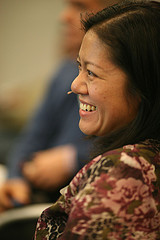 Li by Thomas Hawk via Flickr
The Personal CPM: Quirky Idea or Future Marketing Reality?
Li by Thomas Hawk via Flickr
The Personal CPM: Quirky Idea or Future Marketing Reality?
Moderator: Charlene Li, Founder, The Altimeter Group
David Honig, Co-Founder, Media6Degrees
Joe Marchese, President, SocialVibe
Jamie Tedford, Founder/CEO, Brand Networks
Eric Wheeler, CEO, 33Across
Q: Something about the social graph. Charlene's mic isn't working well.
Eric: With media, it's about the connections between people and the strong bonds. You can use social network theory to model your audience.
Joe: The idea of packaging the social graph is simple. You used to advertise to people. Now you're advertising through people. [My take: this creeps me out the way he says it, and I'm good friends with Joe. If I think advertisers are marketing through me, I'm going to start clamping down.]
David: With social graph activities, as long as it's anonymous, you can find the nodes that matter to you.
Jamie: It's interesting if it's not anonymous. Sears did a campaign. They're giving away $10 gift certificates to become a fan of the page. They realize the lifetime value of what they pay for the media plus $10.
David: You're never going to get lifetime value just by that one time action (e.g. becoming a fan).
Joe: There are two ideas. One is the consumer as a source of media. ... People have a personal CPM they have to be compensated for. You want people to spread your brand intentionally, not by accident. That takes planning.
David: Compensating them is another topic. I'll use my Duane Reade card to save a dollar but I won't give them access to my credit card. ... There have to be rules.
Jamie: We're comfortable with poitns programs. How come we're not comfortable with rewarding true engagement?
Joe: You've got to say these people are publishers of social content and go from there. ... You can reward people for sharing your brand.
Eric: Like microlending, we'll see stuff happening with microblogging. We'll see ways to rank/score people on a consistent basis. [Me: This is also freaking me out a bit if I think everyone's scoring me. As if the pressures to conform weren't bad enough in high school...]
Jamie: I always believed Facebook and MySpace were CRM systems - building fan lists, etc. The goal is to aggregate users and fans. They are hand raisers, and by doing that they're more valuable and more credible.
Joe: There's an idea of user-generated targeting. ... It's a lot harder when you used to buy advertising and now you're trying to get people to share Colgate.
Charlene: Is it all about tapping evangelists? Not necessarily. It's about tapping into people's passions.
My Q'creepy' Image via Wikipedia: How do you avoid creeping people out?
Via Twitter:d_rey: @Jack2point0 RT Awesome quote: "the more you guys talk, the more you creep me out" #ommasocial
Eric: Behavioral targeting was all about the marketer. With social media, 70% of US is involved in social networking. Charlene Li has said social networking will be like air. We'll see more players in this space giving back to people and making it more valuable. People will get back
David: Is it creepy when you walk into the grocery store and they know all this about you. {missed the rest of this]
Joe: Sorry for creepign you out. Any medium can be abused. I see social media getting abused daily online. You avoid a lot of it simply by asking people for permission.
Jamie: To me, it's a kinder, gentler marketing. It's 'marketing with' instead of 'marketing to.'
Charlene: Remember Caller ID when it first came out? That really creeped out people too. [Umm, but that's not marketing.]
[My overall take on this: I still don't think they fully address how creepy it is to market through a person and piggyback on their personal brands. Marketing to someone is far more passive and innocuous.]
![Reblog this post [with Zemanta]](../../../reblog_e_x-id-25021c79-674d-4fe2-be96-e093edd728c2.png)
OMMA Social Panel: Seen But Not Heard; When Is It Appropriate for Brands to Simply Listen?
 Cover of Listen
Seen But Not Heard; When Is It Appropriate for Brands to Simply Listen?
Cover of Listen
Seen But Not Heard; When Is It Appropriate for Brands to Simply Listen?
Moderator:
Cory Treffiletti, President/ Managing Director, Catalyst:SF
Shane Ginsberg, Executive Director, Global Business Development, Organic
Gary Goldhammer, Senior Vice President & Director, Client Services West, Edelman Digital
Martin Green, COO, meebo
Matt Sanchez, CEO, VideoEgg
Rich Ullman, SVP of Marketing, Ripple6
I missed the first bit of this as I got back into blogging mode following some post-panel chatter.
A panelists asked if listening is a must, and everyone generally agreed.
Martin: Brands want to know what specific demos are doing, not just generic.
Matt: There are a lot of ways to listen. With video, I'm looking at the consumption curve of what video looks like. [My take: YouTube Insights has the best platform out there for this that's free for content producers.]
Cory
Cory Treffiletti / Catalyst:SF
via CrunchBase: What do you do with info once you hear people talking about you.Martin: If I'm on Meebo and IMing my friend I don't want to find out a brand's hovering over my shoulder. But I don't mind if it's aggregated and not an invasion of privacy. In an intimate, semi-open blog, I don't want a brand there. It's contextual.
Rich: If a brand wants to have a conversation with me, it goes from the realm of eavesdropping to people inviting the brand in.
Shane: P&G has a place for people connected with feminine hygeine products to talk. When is it appropriate? [My take: P&G did a good job expanding this to make it more about female-specific issues and concerns rather than the products. But it's still a valid question.]
Martin: One thing we've found is that our users love to answer polls. Brands can take part in these, and then share the answers back with the group while learning the answers.
Gary: With P&G, I hope if I'm a young woman it's someone like me and not some marketing person I'm engaging with.
Cory: It sounds like it's good for brands to participate in social media. What harm can come to brands?
Shane: Dell got in trouble for not listening.
Matt: Brands can create a community and set the wrong expectations for it.
Martin: It's inappropriate if there are privacy issues. There also has to be a distinction between marketing and advertising.
Rich: The worst thing? You say you're going to participate in the conversation and then all of a sudden you stop. That can be a bad thing because people will say you're not listening anymore. Also... For a community of 13 year old girls, you put in someone who understands 13 year old girls
Gary: For something for an auto show, we had a real auto enthusiast run it. For the next week then, the guy didn't do anything. The comments in the days after - people got pissed off. The reaction was that he was just there to sell cars. Really, he just went on vacation for a week. We didn't set expectations first.
Shane: That's a structural problem with with social media. I call it the social media magpie effect, running from one platform to another.
Cory: A lot of people seem to look at social media as reactive. You're talking about it as being there for the long haul.
Shane: You have to be careful with expectations going into it.
Q from Perry Hewitt @perryhewitt: When should brands listen in certain white-label communities vs. the whole web?
Rich: White-label communities are affinity based created around brands or ideas. The stuff I care about on the internet is a small bit but it's huge to me. The more you narrow it down, the more manageable it's going to be.
Matt: With the white label network, you also factor in the effort to narrow it down and manage that.
Selected tweets from during the session:
pchaney: #ommasocial sessions are consistently good; love hearing industry pundits speak from framework of experience. Else, gr8 job faking it.
perryhewitt: Worst thing a brand can do online is to engage then stop. Didn't @peterkim have a gr8 analogy of 1-night-stands vs relationships?#ommasocial
tylerwillis: @ommasocial "The messenger is just as important as the message in social media -- people relate to similar people."
ysnjen: #OMMAsocial: Cory Treffiletti is a fantastic moderator. Saw him at my first OMMA and this is my 4th or 5th conf now.
dspark: #OMMASocial. @julieannalittle If women discuss their cycle on PG.com, do they all start getting in sync?
convagency: "Do brands really want to hear all the conversations surrounding them? " Goldhammer from Edelman. I would argue they should. #ommasocial
perryhewitt: Brands need to differentiate when listening between the "what" and the "so what". What's baseline, and what's actionable? #ommasocial
perryhewitt: Worst thing a brand can do online is to engage then stop. Didn't @peterkim have a gr8 analogy of 1-night-stands vs relationships?#ommasocial
tylerwillis: @ommasocial "The messenger is just as important as the message in social media -- people relate to similar people."
ysnjen: #OMMAsocial: Cory Treffiletti is a fantastic moderator. Saw him at my first OMMA and this is my 4th or 5th conf now.
dspark: #OMMASocial. @julieannalittle If women discuss their cycle on PG.com, do they all start getting in sync?
convagency: "Do brands really want to hear all the conversations surrounding them? " Goldhammer from Edelman. I would argue they should. #ommasocial
perryhewitt: Brands need to differentiate when listening between the "what" and the "so what". What's baseline, and what's actionable? #ommasocial
![Reblog this post [with Zemanta]](../../../reblog_e_x-id-29344904-fdf2-4055-8dfd-d70e6b8d17dc.png)
OMMA Social Keynote: Angela Courtin, SVP Marketing, Entertainment & Content, MySpace
 Image via CrunchBaseOMMA SOcial Keynote: Angela Courtin, SVP Marketing, Entertainment & Content, MySpace
MySpace is combining social media and portals into a social portal.
Five-year-old company, profitable "since [they] turned the lights on."
40% of all online moms are on MySpace. They're online 11 hours a week.
"As usage shifts to social networking, there is no longer a race to build destinations but constellations."
This has become a sales pitch. I'm not going to blog as much about that. I can only take so much. My tweet on this: "MySpace keynote devolved into tedious sales pitch really quickly. Plus, while she's talking, I'm checking Facebook. #ommasocial"
This got some fun responses on Twitter:
davehonig: @dberkowitz, @joemarchese,@lazerow, i was expecting more of a keynote. some more thought provoking less pitch.
szetela: @dberkowitz is MySpace a sponsor?
szetela: @dberkowitz is MySpace a sponsor?
markdrosos: Sitting next to @dberkowitz and agree on the sales pitch of myspace. Took about 4min.
ryanswagar: RT: @dberkowitz MySpace keynote devolved into tedious sales pitch really quickly. = of course it did! That's what you do when your Co SUX
And it continues...
Now she's telling the OMMA Social audience how the social graph works. So glad this is groundbreaking.
Got 13 million downloads of a Chevy Tree planting widget where you have to water it every day. Okay, I'll blog that.
Event Photo from Derek Rey - @d_rey on Twitter via Twitpic:
More fun from my Twitter feed:
dberkowitz: oddest audience question so far at omma social: what's the best computer and web browser for viewing myspace?
socialmedium: @dberkowitz that is seriously bizarre. What was the answer?
dberkowitz: @socialmedium she answered, "uhh, i use a mac." and then Q'er asked, "and firefox?" she said, "okay, sure" - don't get it #ommasocial
![Reblog this post [with Zemanta]](../../../reblog_e_x-id-7a82b3a1-befd-4a79-b2cb-d42c86bfa3a4.png)
Around the Web


Become a Fan
Search

About

Who's David?
- David Berkowitz is Chief Marketing Officer at agency MRY. A frequent speaker and media pundit, he has been published hundreds of times in MediaPost, Ad Age, eMarketer, Mashable, and elsewhere. Get to know him in the links below the blog's header.
Contact
- marketersstudio (@) gmail (.) com

David Berkowitz
4
Following
4,289
Followers


Recent Posts
- How Newton's Third Law Applies to SXSW
- Spring Events: Kids and Cars, Romancing the C-Suite, CMOs Gone Wild
- Follow the SXSW Chat on Storymaking with German Haus
- #DamnSXSW: The Only SXSW Preview You'll Ever Need
- Es ist Deutschland Week in MarketersStudio.com
- Kommen Sie mit mir auf Deutsch Haus auf dem SXSW
- Meet up at Mobile World Congress?
- 13 Things to Know about the Alpha Generation
- CES 2016 in Review: The Autonomous 4K VR 3D IoT Drone Awakens
- Quiz: How Well Do You Know CES Tech Flops?
Categories
- Advertising
- Blogs & Blogging
- Books
- Campaigns
- Columns
- Conferences and Events
- Consumer Generated Media
- Customer Service
- Emerging Media
- Flubs, Gaffes, and Blunders
- Food and Drink
- Fun
- Games
- Games, Gaming, Video Games
- Innovation
- Invites
- Jobs
- Marketing
- Measurement
- Media
- Microblogging
- Mobile
- Movies, Music, TV
- Personal
- Photography
- Politics
- Presentations
- Public Relations
- Religion
- Research
- Search Engine Marketing
- Search Engines
- Search Insider
- Shopping and Retail
- Site of the Day
- Social Action, Do-Gooding, Philanthropy
- Social Media
- Social Networks
- Sports
- Startups
- Technology
- Television
- Tips
- Tools
- Totally Nuts
- Travel
- Trends
- Video
- Virtual Worlds
- Widgets and Gadgets
