« July 2012 | Main | September 2012 »

Posted at 11:01 AM in Technology, Tools | Permalink | Comments (0)
This is a bittersweet column to write, as I've been spilling digital ink in MediaPost for most of my career. I will continue to keep the blog current, even if it takes some time to figure out what that flow will be like, and I'll continue to contribute to other publications like Ad Age and Mashable, and likely others such as Digiday. One shout-out must be added here: thanks go to Mark Naples of WIT Strategy, my boss (for a brief window) at iCrossing in 2004, who introduced me to MediaPost and got me on board there as one of the first Insider writers. There are then many others at Viewpoint / Unicast and then especially 360i who have supported this endeavor over the years -- too many to name here.
With that, here'd edition #401:

What I've Learned, 400 Editions Later
originally published in MediaPost's Social Media Insider
On July 2, 2004, I penned a Search Insider column for MediaPost that quoted Dr. Seuss and Eminem, followed it up 18 days later with a biblical allegory about search engine optimization, and nearly every week since then, I contributed to an oeuvre here that ultimately numbered 400 editions. So as not to bury the lede, this is my final Insider edition – at least for now.
Since I’ve had the honor to contribute an estimated 300,000 words here (my apologies to copy editors and readers for testing your patience), I hope you’ll indulge one final entry that goes behind the scenes of this 97-month journey. Here’s what I’ve learned:
1) Know your voice. When I started writing the Search Insider, I was daunted by other pundits who knew far more about search engine marketing than me, and all of them seemed to be named Kevin. Accepting my lack of experience, I put people (also known as consumers, and sometimes users) at the center, and then figured out where marketers fit in. That gave me enough time to learn more about marketing on the job (through three jobs in fact, though mostly at 360i) and hone that aspect later.
2) Big ideas matter, even if they don’t spread. When I’ve had what I thought was a great idea – such as The Motivation Bubble – hardly anyone seemed to respond. I’m still proud to have shared such columns. Perhaps they shaped the thinking of some people who never responded, and at the very least I felt some sense of achievement just going through the process of refining the idea.
3)Go off topic. When I feared I was heading too far off topic and wrote the story anyway, it would get the greatest response. Speaking of which, my grandmother featured in “Google vs. Grandmom” remains in good health, gave up on the Internet, and still has all the answers to everything – regardless of whether you seek her opinion.
4) Count on numbered lists. I resort to numbered lists a lot, for three reasons. First, they’re easier to read, and I have a short attention span. Second, numbers in headlines grab attention. Third, they’re a fun challenge – a creative dare. Often, I’ll have writer’s block, and then come up with one or two ideas around a similar theme. I’ll then jot those down and think about how many more I’d need for a decent list, whether it’s 5, 10, or occasionally 100. Then I’ll force myself to get near that number, adding or subtracting a few to keep the best ones in. If the piece works when it’s finished, it delivers the writer’s equivalent of a runner’s high.
5) Expect writing to take longer than expected. In writing 400 columns here, you’d think I could crank them out. It’s never the case though. Each column is a learning experience, starting with a thesis, or a hypothesis, or a half-decent idea for the middle of a non-existent story. The journey ventures from there, spanning links, images, old emails, LinkedIn profiles, and quotes (often later omitted) from sources such as the Bible, Baruch Spinoza, Sherry Turkle, “30 Rock,” and “Calvin and Hobbes.” Practice doesn’t make perfect; practice makes perfectionism. I know not every post is amazing, but I still put in the time. It takes just as long to write an average column as it does to write a great one.
6) Your time and attention are priceless. I don’t devour analytics to determine how many people read each column. All I know is that to keep writing this many, some people must be reading them. While it’s impossible to know exactly who is reading what, I am so moved that you and others have taken the time to read any of it. My goal with any column is simple: to respect your time. I can only hope I have remotely succeeded.
7) It’s time to eat the grapes. This Insider series will continue with other talented writers; keep reading them, and I’ll do the same. As for me, I’m hardly going silent; I’ll continue to cobble together thoughts on media and technology through my blog and potentially other endeavors. The process of transition stirs up a range of emotions that have been expressed better by others. A retiring college professor once told his students that he wished them “the humility required to feel truly appreciated, and the wisdom required to know when it is best to move on.” Quite a few years earlier, the Stoic philosopher Seneca wrote, “As it is with a play, so it is with life – what matters is not how long the acting lasts, but how good it is.” One can only pause and reflect for so long. As quoted in Roger Housden’s book “Saved by Beauty,” the 13th century Persian poet told his listeners, “Remember the proverb, ‘Eat the grapes.’ Do not keep talking about the garden. Eat the grapes.”
With that, it’s time to move on. As Scotty famously warned in “Star Trek IV,” “Hold on tight, lassie! It gets bumpy from here.”
Posted at 10:20 AM in Columns | Permalink | Comments (2)

10 Ways Facebook Has Changed Since 2004
originally published in MediaPost's Social Media Insider
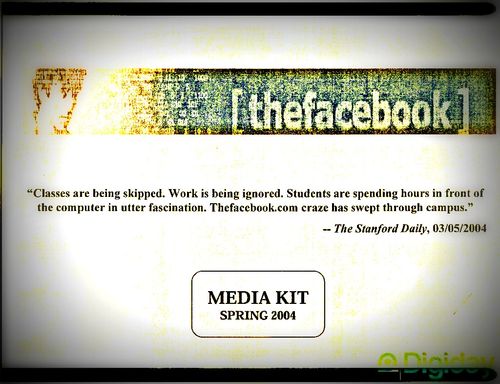
Facebook has earned a few degrees since it launched as Thefacebook in 2004. A Facebook media kit from the spring of 2004 recently surfaced, and it offers a glimpse as to how much has changed since then. Here are 10 quotes from the media kit that illustrate what has changed with Facebook, media, and online advertising.
1) “Thefacebook.com is an expanding online directory…”
This is so quaint. Remember the directory-centric era of the 1990s? As innovative as Thefacebook was, it was selling itself as a form of online media that was a relic by 2004. Months after this media kit was published, Google went public and accelerated the demise of browsing through directories.
2) “Additionally, thefacebook.com automatically adds to each user profile links to school news articles that refer to the user, the last user away-message in the AIM system and the last user access location…”
Facebook was a potential lightning rod for privacy lawsuits right from its birth. Did users realize this in 2004? Did they care? Even if it was only used by college students at the time, these students couldn’t have wanted to share all of this information with advertisers.
3) “Advanced search engine”
LOL. If Thefacebook had an advanced search engine in 2004, what the heck happened to it?
4) “Additionally, each user can add a friendship list to their profile, pending second-source verification of friendship status.”
Given Thefacebook’s birth in a dorm room full of Harvard computer scientists, it’s funny to see words like “second-source verification” slip in and overcomplicate simple ideas. Yet it’s also important to remember that in 2004, most people -- especially those older than 25 -- had little idea what a friend request was. This was before “friend” was a verb.
5) “The mission of thefacebook.com is to expand to include most of the schools in the United States.”
The company’s publicly stated mission had nothing to do with world domination. It wasn’t even sure it would get to every college and university.
6) “With an estimated purchasing power that exceeds $85 billion, college students have money in their pockets for your services and products.”
As simplistic as it sounds, this is one of several cases where I wonder if Facebook lost something as it grew up. Here, the media kit included the kind of straightforward language that advertisers expect. It made Thefacebook seem safer for advertisers, rather than some entirely new paradigm.
7) “Unique Users,” “Traffic,” “Pageviews”
Facebook was selling eyeballs in 2004, as was nearly everyone. Now Facebook is known for engagement and building relationships. None of that was possible on Thefacebook eight years ago.
8) “You can target users using traditional horizontal/vertical banners, links and other more contextual ad placements.”
Facebook hates this today. The media kit was created before the current era of native ad formats. Now it’s a badge of honor to sell proprietary units and offerings, and Facebook was one of the most adamant promoters of going native. Yet Facebook hasn’t fully evolved from its eyeball-oriented past. By cramming seven small ad units on the righthand rail of a page, Facebook today is a master at devaluing its own inventory.
9) “House/Dormitory,” “Sexual Orientation,” “Number of Intra/Inter-School Friends”
These are some of Thefacebook’s ad targeting options -- just three of 16 listed. At the time, targeting by one’s number of friends made sense, as online popularity could be assumed to be a proxy for influence; that notion has since been refuted. Facebook has evolved considerably. For instance, earlier this year, Facebook made a change to let advertisers target broad categories such as small-business owners, U.S. Hispanics, people who recently moved, and expecting parents. This is one significant way where Facebook has improved ad offerings to give advertisers more of what they need.
10) “Mobile”
Actually, this word isn’t in the media kit at all. In 2004, Facebook wasn’t a platform, it wasn’t a social utility, and it surely wasn’t mobile. Selling mobile advertising is hard enough today, though it’s increasingly profitable and scalable. Back then, it wasn’t part of the plan.
It didn’t need to be. Thefacebook was a site for college kids to engage in second-source verification, and advertisers could run banner ads targeting the most popular heterosexual or homosexual kids in certain dorms. Facebook maintains some of Thefacebook’s roots, but with about a billion users, it’s something quite different. What isn’t clear is exactly what Facebook is. Some younguns these days take forever to figure out what they’ll be when they grow up.
Posted at 02:20 PM in Columns, Social Media, Social Networks | Permalink | Comments (2)
Technorati Tags: advertising, facebook, thefacebook

Last week, the world lost a masterful educator and a remarkable individual, Pat Kelly. I'm tempted to post her photo from her obituary, but it doesn't do her justice, capturing nothing of her enthusiasm for education (a high school newspaper photo will have to do). It also captures nothing of the terror she invoked in students who would be threatened with a visit to her office at the Solomon Schechter School of Westchester, where she served as Assistant Head of School during her more than 25 years there. She was a warm and wonderful person, but had a memorable reputation as the 'bad cop' in school, and her reputation alone kept thousands of kids in line over the years.
It's also odd to refer to her as Pat - it's borderline 'sacrilegious' (a word loaded with added meaning in reference to a woman who was once a nun and went on to help run a Jewish private school). She was always Mrs. Kelly, and I don't know if I ever had any exchange with her after leaving Schechter. I'm not on a first-name basis with her just yet.
Pat - that is, Mrs. Kelly - was my eighth grade math teacher. I had actually been thinking about her recently before her passing, having just finished "The Honest Truth about Dishonesty" by Dan Ariely. Much of our classwork was graded on the honor system, where we'd read aloud our assignment scores one by one, and no one would check how honest we were. I did alright academically. With math though, I typically made it to the advanced class but barely got by, bringing up the rear of the pack of the more numerically-gifted. I wonder how many times I inflated my grade - never by much, but just enough so I'd never feel too far behind the class. I wonder how many others were inflating their grades too, though maybe they didn't need to. It felt all too familiar reading Ariely's book, which notes that most of us will cheat by just enough to benefit ourselves while still maintaining the self-image that we're generally honest people.
There is one lesson from Mrs. Kelly that I remember well to this day, a lesson that nearly all of her math students probably retain. At the start of the year, she made her students memorize and internalize a single axiom:
"The more senses you bring into the learning process, the more lasting will be the learning."
I never forgot it, even though it's been 20 years since I sat in her class. If I had any doubt as to how well I remembered the sentence verbatim, the words reappeared in my inbox in a message from Schechter Headmaster Elliot Spiegel announcing his former colleague's passing:
Pat was a master math teacher to generations of Schechter Westchester Middle School students whose motto, "the more senses you bring in to the learning process, the more lasting will be the learning," became a guide to her students throughout their school careers.
What's far more meaningful is that in high school, college, and my professional life, I would repeatedly internalize Mrs. Kelly's lesson. I'd find ways to recite things aloud so I could hear them. I'd write out important passages long-hand so I could commit them to memory. I'd push myself not so much to be creative but to learn in creative ways. I didn't do this nearly enough and still could do this more; as authors tend to write in acknowledgements, Mrs. Kelly contributed to my successes, but my mistakes are all mine.
I can't remember a single math lesson from eighth grade, at least nothing specifically. I think I also avoided the dreaded assistant principal's office. I remember her voice though, her manner, and more importantly those words of hers:"The more senses you bring into the learning process, the more lasting will be the learning."
Thanks, Mrs. Kelly. Your words and deeds are still with us.
Posted at 05:48 PM in Personal | Permalink | Comments (1)
Technorati Tags: education, eulogy, tribute

Six Chickenpants of Separation
originally published in MediaPost's Social Media Insider
One morning, I arrived at work to find an unexpected visitor waiting for me at my desk. Short and bald, he was shirtless and wearing the most extraordinary pair of pants. He goes by the name Agent 011, but his real name is Chester Chickenpants, and he may be your next social media role model.
After Chester journeyed to Manhattan, he revealed that he’s part of an elite group, the Chickenpants Adventure Society. It describes itself as “an elite breed of plush toy, sent out into the world to spread the joy of random serendipity.” In other words, it’s an entire organization dedicated to surprising and delighting, just like every trendy brand these days.
The rules of the Society are simple: “1. Get the Chickenpants dropped in the most interesting spots possible. 2. See who picks them up.” People who discover an agent are instructed to email headquarters. A blog tracks the adventures of the agents who are found.
There’s something wonderfully purist about the whole enterprise. There’s this warmth that comes from those moments of weird, creative joy inspired by the Internet’s manifold ways to bring people together. Could the world unite around the Chickenpants Adventure Society? Imagine the Sabra Dipping Company commercials where people of every nationality gather around a potluck meal, but in this case there would be less hummus and more toy chickens in colorful pants.
Then again, digging deeper, there’s a commercial underpinning to it. Chickenpants does have a shop on Etsy. Still, it’s not the kind of enterprise where it’s all a ruse to get people to buy tiny $10 gifts. Then again, if the Adventure Society turns Chickenpants into the next LEGO, so much the better.
At the risk of totally bastardizing the purity of Chickenpants for the purposes of a marketing publication, people managing much larger brands can learn a few things from this toy poultry phenomenon. Here’s what you should learn from Chickenpants:
1) Consumer behavior is centered on mobility, not mobile devices. While Chester Chickenpants may be a “dumb” device technologically (sorry, Chester!) given his lack of digital connectivity, it’s a prescient indicator of where mobile social media is heading. Anything can be a mobile device, and a trigger for mobile experiences. Chester is portable, a conversation-starter, and can even stay in your pocket when you head through airport security. Maybe this is what the iPhone 5 will look like.
2) The physical and digital worlds are inseparable. Chester Chickenpants can live entirely in the physical world, but the poor doll would be like the fallen tree in the woods, barely making a peep. It’s thus fair to assume that the raison d’être for Chester is to live digitally -- to be shared online, and then in person, and then online again. A Chester that’s only digital is flat, missing the substance of a corporeal self that could be held (and even pecked), even if relatively few will ever encounter his physical form.
3) “Just because marketing” is the new cause marketing. Why would creator Claire Chambers let Chester Chickenpants and friends escape the coop on this global adventure? What’s the ultimate point? What, pray tell, is the return on investment? It’s an experiment, with the likely hypothesis that it’s more fun to do this than not to do this. The key metric, then, is not sales of Chickenpants postcards, but in the responses received indicating some level of fun, or the lack thereof in the event that the hypothesis is disproved. Claire found a way for the Chickenpants brand to grow as it travels the world literally and virtually.
There are two things Claire has going for her: the undying popularity of both chickens and pants, with pants being 6.8 times as popular than chickens globally, and 2.4 times as popular in South Africa (source: Google Trends). She also has an uncanny grasp of some of the bigger trends and changes marketers must grapple with. If a short, bald, shirtless visitor with the head of a chicken shows up at your desk, check to see if he’s wearing remarkably fashionable pants. If so, pay attention. If he’s not wearing pants, you might want to call security.
Posted at 01:33 PM in Columns, Social Media | Permalink | Comments (3)